Selection and Breeding

Breeding the Perro
Lobo Español

Introduction

Necessity
as a criterion of selection

In the mountain and forest-edge areas, where people lived in close contact with wild fauna and where property had to be protected without artificial means, the lobero became a necessity rather than a choice.

The lobero was not bred out of fondness, but out of practicality. A dog that failed at its task disappeared without leaving offspring; the one that endured, watched and deterred, remained. In this way, with no breeding programmes or written standards, a recognisable canine type was fixed and passed down from generation to generation.

With the progressive abandonment of rural life and the arrival of urban models alien to the land, the lobero began to disappear or to be diluted in indiscriminate crosses. Today, its recovery necessarily means acknowledging its past and respecting its nature.

Responsible breeding of the PLE does not seek to manufacture an aesthetically uniform dog, but to preserve an authentic functional type: hardy, balanced and true to its land.

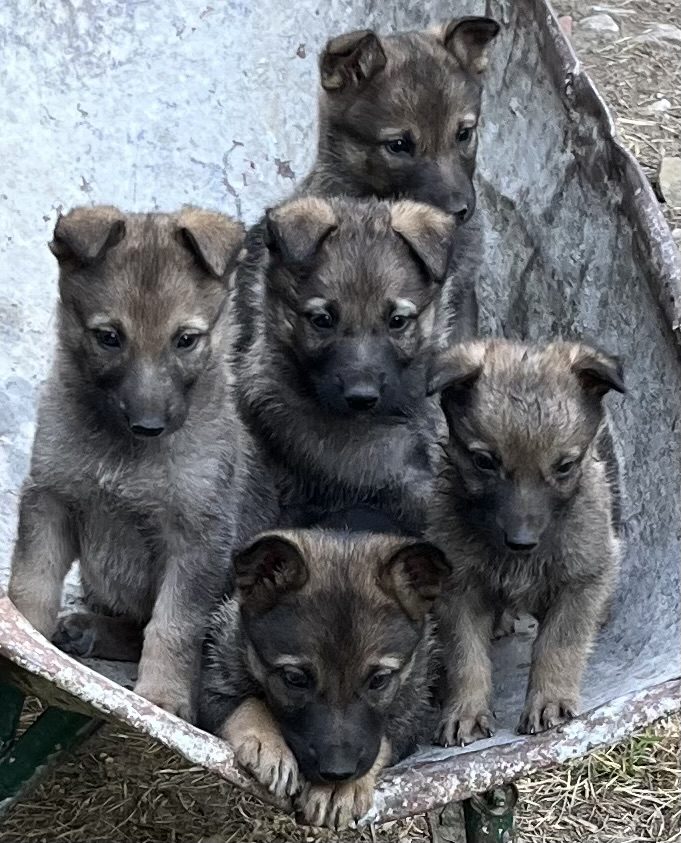
Perro Lobo Español puppies

A litter of PLE puppies

Breeding Guide

Criteria for responsible
breeding

The PLE breeding guide is based on the principles of functional selection, preservation of genetic diversity and respect for the breed's original character. Unlike other breeds, selection does not prioritise aesthetic uniformity but consistency with the original type.

Selection of breeding stock

  • Preference for specimens of documented origin in northern Spain
  • Assessment of character: balance, confidence, territorial instinct
  • Evaluation of structural health and absence of known hereditary conditions
  • Avoid breeding from specimens with severe hip dysplasia or unstable temperament
  • Genetic testing recommended to certify purity of type

Mating control

  • Avoid high consanguinity: inbreeding coefficient below 6.25%
  • Diversify bloodlines to maintain heterozygosity
  • Record every mating in the association's register
  • Recommended age for first mating: females at least 18 months, males at least 12 months
  • The association is working to define a limit on litters per female consistent with animal welfare and the sustainability of breeding; this criterion will be published once established

Pregnancy and whelping

  • Average gestation: 63 days (±3 days)
  • Veterinary check at the beginning and end of gestation
  • High-quality feeding during gestation and lactation
  • Whelping in the PLE is usually uncomplicated; the female tends to whelp unassisted
  • Usual litter size: 8–12 puppies, reflecting the reproductive vigour typical of a primitive breed not subjected to intensive selection
  • Gradual weaning from 6–7 weeks

Puppy development

  • Early socialisation: gradual exposure to people, animals and varied settings from 3 weeks
  • Minimum age for handover to the new owner: 8 weeks, preferably 10
  • Health follow-up at the discretion of the owner or trusted vet
  • Internal and external parasite control according to the conditions of the environment
  • Microchip compulsory before handover
  • Full documentation: pedigree, health certificate, sale contract

The association is drafting the official Breeding Book of the Perro Lobo Español, which will set out the breed standard, selection criteria, health protocols and the genealogical registration system. Publication is planned once official recognition by the RSCE is achieved.

Good Practice and Management

Living with the lobero

The Perro Lobo Español is not a dog for every owner or every setting. Its character, forged through centuries of autonomous work, calls for specific handling that respects its nature.

Space and exercise

The PLE is a country dog. It needs ample space, preferably with access to the outdoors. It is not recommended for flats or apartments. Daily exercise is essential: at least 60–90 minutes of physical activity for an adult. A lobero without enough space and exercise may develop destructive behaviour or anxiety.

Socialisation and training

Early socialisation is essential. The puppy should be exposed gradually to different people, other animals, vehicles, urban noise and new situations between 3 and 14 weeks. A well-socialised PLE is a balanced, dependable dog; a poorly socialised one may become excessively wary or reactive. Training should be firm, consistent and based on positive reinforcement.

Relationship with the owner

The lobero is intensely loyal to its family circle. It may be reserved or wary with strangers, which is part of its guarding character and should not be read as aggression. It calls for an owner experienced with strong-charactered breeds, able to provide clear and consistent leadership without resorting to coercive methods.

Feeding

The PLE is a hardy breed with modest nutritional demands compared with highly selected breeds. It adapts well both to good-quality kibble and to a raw natural diet (BARF or similar), which many owners and breeders consider the option most consistent with the breed's biology and history. For adults, one meal a day is enough. Avoid overfeeding: obesity is the main avoidable health problem in the breed.

Health and veterinary care

The PLE is one of the dog breeds with the greatest documented longevity in the Iberian Peninsula: it is not unusual to find specimens over 16 or 18 years old in good condition. This robustness is the result of centuries of natural selection without artificial intervention, under demanding living conditions that eliminated any constitutional weakness. The breed shows a low incidence of hereditary conditions compared with recently created or intensively selected breeds. Owners are free to set the health protocol they consider most suitable for their animal, in consultation with their trusted vet. In medium-to-large breeds it is wise to keep an eye on hip and elbow dysplasia. Coat care is simple: weekly brushing and occasional baths.

Breed Particularities

What makes the Perro
Lobo Español unique

Character and temperament

The PLE is a dog of strong character: independent, intelligent, territorial and extremely loyal to its own circle. It is not a submissive or eager-to-please dog —nor was it ever—. Its loyalty runs deep, but it is earned, not bought with treats.

It shows a natural wariness of the unfamiliar, which makes it an excellent guardian but calls for careful socialisation so that this wariness does not turn into reactivity. With its own people it is a calm dog, affectionate in its own way, and of great presence.

The lobero's intelligence is high but practical: it quickly learns whatever makes sense to it. Blind obedience is not its strength, but its cooperation with the owner in real working or guarding situations is exceptional.

Characteristic morphology

The PLE has a lupoid morphology: a well-proportioned body, medium to medium-large in size, with compact musculature and no excess. The head is wedge-shaped, with erect or semi-erect ears and eyes of lively, alert expression.

The coat is double: a dense undercoat and a longer, more resistant outer coat, adapted to the damp, cold climate of northern Spain. The most usual colouring includes wolf shades —grey, brindle, sable— though there is variability.

Unlike the German Shepherd, the PLE has neither the sloping croup nor the arched back characteristic of that breed. The topline is horizontal and the whole conveys balance and solidity.

The PLE as a working dog

Historically, the lobero guarded flocks, protected property and, in some cases, assisted in hunting. Its main function was not active herding but guarding and deterrence: presence, alertness and defence.

This role has given it an independence of judgement that sets it apart from obedient herding dogs: the lobero decides, assesses the threat and acts. That independence is an asset in the countryside and a challenge in urban life.

Adaptation to its environment

The PLE is extraordinarily well adapted to the climate and terrain of northern Spain: rain, cold, fog, rough ground. It copes poorly with extreme heat and is not designed for Mediterranean climates without shade and plenty of water.

Its physical endurance is remarkable: it can live outdoors all year round in northern Spain with no more shelter than a well-placed kennel. Outdoor life, with access to ample space, best suits the welfare of the breed.
Registration of Specimens

Genealogical register

The association maintains a provisional register of Perro Lobo Español specimens while official recognition is obtained and the definitive studbook is established. Registration certifies the association's assessment of the specimen and allows its genealogical tracking.

01

Request for assessment

The owner or breeder requests an assessment of the specimen through the contact form, providing photographs of the dog, details of its origin and, where available, genealogical documents of its parents.

02

Morphological and documentary evaluation

A representative of the association evaluates the specimen: morphological assessment against the criteria of the PLE type, verification of origin and review of the documentation provided. This evaluation may be carried out in person or through an arranged visit.

03

Genetic analysis (recommended)

Genetic analysis of the specimen is recommended, though not compulsory at this stage. The association advises on the available laboratories and on which markers should be included so that the sample is useful for the register and for future studies of the breed.

04

Entry in the register

Once the specimen has been validated, it is entered in the association's provisional register. The owner receives a certificate of registration and the specimen is included in the breed's genealogical database.

Request registration
Shows

Showing the breed

Shows are a key tool for making the Perro Lobo Español known to the general public, to enthusiasts and to cynological institutions. They allow the breed to be seen as a whole, generate interest and open up debate on selection criteria.

The association is working on organising gatherings and shows of the breed, both internal —for members and breeders— and open to the public. The aim is not to compete with the aesthetic criteria of conventional dog shows, but to show the functional type of the PLE in its natural diversity.

Upcoming shows

The calendar of shows and gatherings will be published soon. If you are interested in taking part with your dog, get in touch.