The Association of Breeders of the Perro Lobo Español was born in 2012 with the aim of promoting, defining, studying and defending the ethnic remnant of this canid left in the mountains of northern Spain, especially in the southern part of Cantabria —hence one of its names, lobero cántabro.
Legally constituted in 2014, the association brings together breeders, researchers, owners and collaborators committed to preserving a breed that came close to disappearing during the 20th century and which today, thanks to rigorous work of documentation and recovery, has a possible future.
We are not an association of enthusiasts for wolf-looking dogs. We are a scientific and cultural association committed to the genetic, historical and functional identity of a genuinely Spanish canine population.
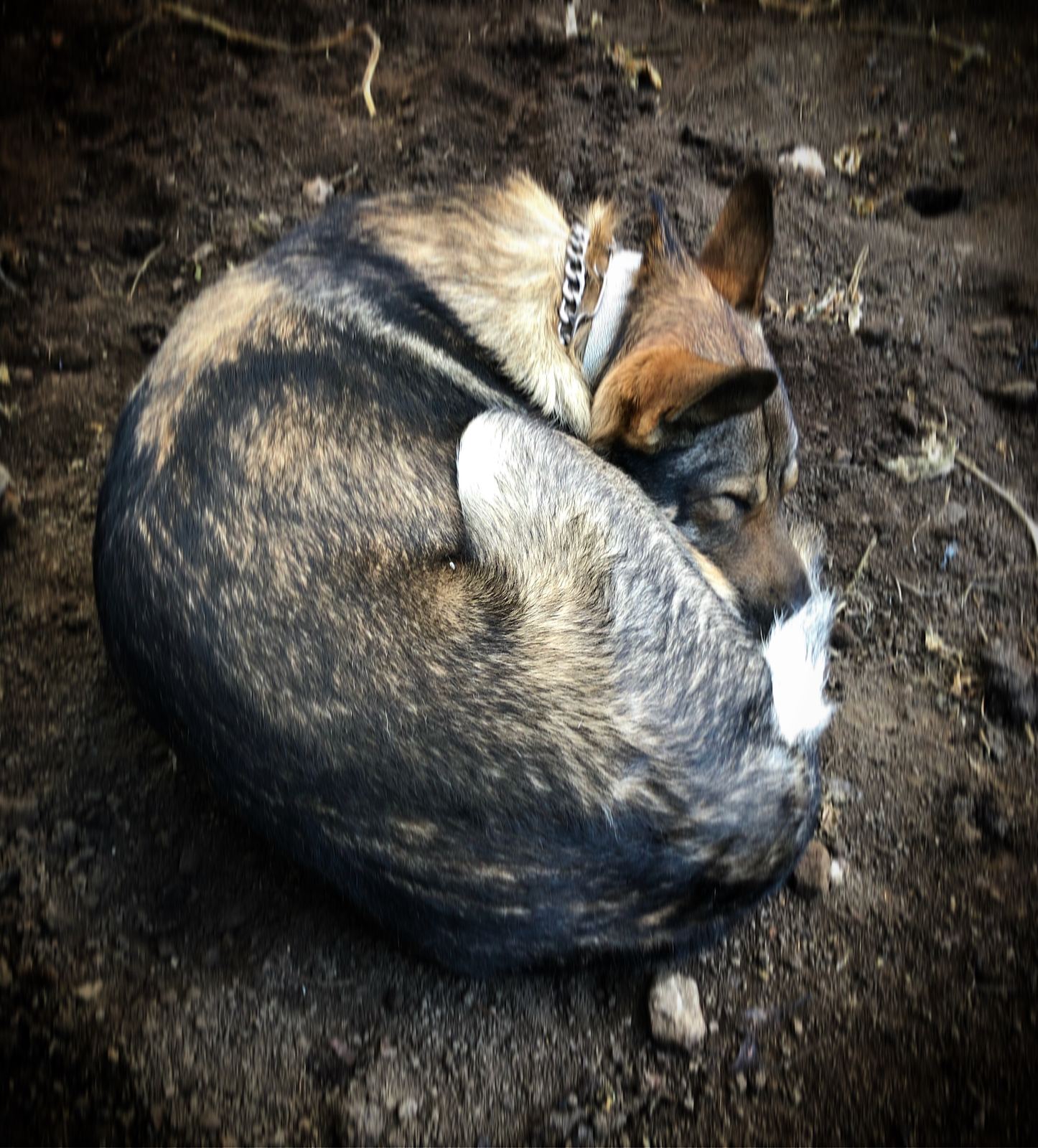
The lobero in its natural setting
The association works along four fundamental lines, from science to outreach, by way of responsible selection and institutional recognition.
To maintain and protect the genetic biodiversity of the Perro Lobo Español, preventing the dilution of its hereditary heritage through crosses with modern breeds.
To build a rigorous documentary corpus —historical archives, regional press, photographic sources— certifying the antiquity and independence of the breed.
To promote and support genetic and ethological studies that scientifically endorse the specificity of the PLE, and to drive their publication in peer-reviewed journals.
To obtain recognition of the PLE as a native Spanish breed before the Royal Canine Society of Spain (RSCE) and the Fédération Cynologique Internationale (FCI).
To maintain the lobero's traditional aptitudes as a guardian, herding and rural companion dog. Function is inseparable from the breed.
To establish a studbook of our own allowing genealogical tracking of registered specimens and guaranteeing traceability in breeding.
The association was born at a meeting held in Reinosa on 5 October 2012, at 18:30. Ten people —breeders, researchers and enthusiasts from all over Spain— came together with a common purpose: to give legal form to a project for the preservation and recognition of the Perro Lobo Español that had been taking shape in the countryside for years.
At that meeting the Association of Breeders of the Perro Lobo Español was constituted, the statutes were approved unanimously and the first Board was elected.
Spanish naturalist and conservationist, driving force behind the recovery of transhumance in Spain and a key figure in the defence of Iberian natural heritage. His presence as honorary president gave the founding project scientific and conservationist backing of the first order.
Breeder and expert on the Cantabrian lobero, with decades of direct contact with the specimens preserved in the valleys of southern Cantabria. First president of the association.
Founding member from Salces, Cantabria, an area of origin and historical conservation of the breed. First vice-president of the association.
First secretary of the association, responsible for formalising the founding minutes and the initial administrative procedures.
Founding member from Reinosa, Cantabria. First treasurer of the association.
Researcher at the Spanish National Research Council (CSIC) and at the National Museum of Natural Sciences in Madrid. His participation as a founding board member linked the association from day one with formal genetic research. He led the first genetic study of the PLE in 2014, which forms the scientific basis of the recognition dossier.
Founding member from Reinosa, Cantabria.
Founding member from Matamorosa, Cantabria.
Founding member from Nestares, Cantabria.
Founding member from Fontibre, Cantabria.
The founding session closed at 20:00 on 5 October 2012. Ten signatures on a document that formally began a recovery project which had been in the making for decades in the silence of the Cantabrian mountain pastures.
The Association of the Perro Lobo Español is legally constituted under Organic Law 1/2002 of 22 March, regulating the Right of Association. Its statutes define internal rules, governing bodies, the rights and duties of members, and the association's purposes.
The statutes expressly state that the association is a non-profit entity, national in scope, with its registered office in Cantabria, whose main purpose is the preservation, study and official recognition of the Perro Lobo Español as a native Spanish breed.
The full statutes are available to download and consult. Constituted under Organic Law 1/2002 of 22 March, regulating the Right of Association.
First formal genetic study of the PLE, carried out in collaboration with the Spanish National Research Council. Analysis of 18 microsatellite markers in 76 specimens, compared against 25 reference breeds. The first scientific document establishing the genetic differentiation of the PLE.
Genetics · 2014Contribution of samples to the Master's dissertation of Belén Villegas Giménez (2017–2019), supervised by Ignacio Doadrio and Annie Machordom at the CSIC – National Museum of Natural Sciences, within the master's programme of the Menéndez Pelayo International University (UIMP). Analysis of 1,248 individuals from 27 populations with 18 microsatellites. Large-scale confirmation that the PLE groups with Iberian lupoids —Can de Palleiro, lobito herreño— and not with the German Shepherd.
Genetics · 2017–2019Contribution of samples to the Master's thesis of Diogo F. C. Lima (2018), supervised by Raquel Godinho at CIBIO-InBio of the Universidade do Porto, with Ignacio Doadrio as co-supervisor. The Perro Lobo Español was analysed alongside fourteen other Iberian guarding and herding breeds with 43 autosomal microsatellites. It confirms its natural fit within the Iberian continuum of rustic dogs and detects a genetic background shared with part of the Carea Leonés.
Genetics · 2018Systematic documentary mining in Spanish historical archives: the National Library of Spain, digital newspaper archives, regional press of the north (Cantabria, Asturias, León, Galicia). Identification of references to the «perro lobo» and «lobero» from 1513 onwards. The aim is to build the documentary corpus needed for the recognition dossier before the FCI.
Historical documentation · OngoingCompilation of historical and contemporary photographs of PLE specimens. Photographs predating 1899 are especially relevant as evidence of the existence of the wolf-like type in Spain before the creation of the German Shepherd.
Documentation · OngoingThe association is working to establish territorial delegations in the regions historically linked to the Perro Lobo Español: Cantabria, Asturias, León and Galicia. Each delegation acts as a local point of contact for breeders, owners and institutions in its territory.
The directory of territorial delegations will be available shortly. If you are interested in representing the association in your region, get in touch.
The calendar of events, shows, technical days and breeders' gatherings will be available soon. Follow us to keep up with the news.
Being part of the Association of the Perro Lobo Español means contributing to the preservation of a unique breed and to building the scientific and documentary dossier needed for its official recognition.
The fees shown are indicative. At present, joining is completely free. To join, use the registration form. A member of the association will get in touch with you.